JOURNAL CENTENNIAL
Cigarette smoke and the clatter of typewriters
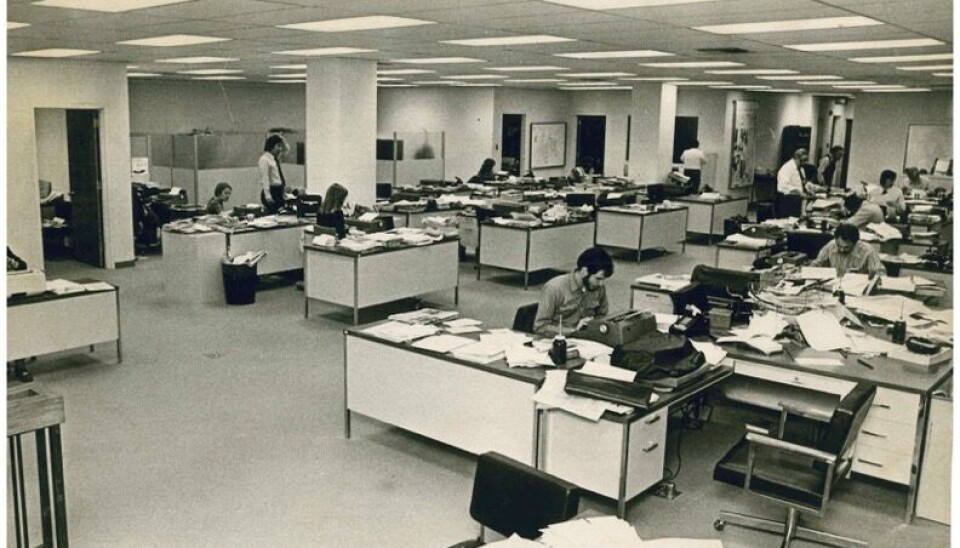
I walked into the Journal newsroom for the first time in 1977. It occupied most of the second floor of a massive, windowless building on Silver Avenue in downtown sa国际传媒官网网页入口. Its windows had been bricked over after the 1971 riots. I was terrified. The room stretched out long before me, and it was literally difficult to see the far end because of the dense wall of cigarette smoke. 鈥淏eier!鈥� a woman鈥檚 voice yelled. 鈥淒o we have this?鈥� She was waving the front page of The sa国际传媒官网网页入口 Tribune, the afternoon paper that competed with the morning Journal. The Tribune had just 鈥渃ome up鈥� from the presses that the newspapers shared in the basement of the building.
Adjusting his tweed vest, pipe in hand, Bob Beier walked slowly from his desk to the office of Frankie McCarty, the managing editor. She called everyone on the staff by their last names. They called her Frankie.
鈥淚鈥檝e got that and a lot more,鈥� he told her, which might have been true.
She smiled. She knew that by the final deadline that night, it would be true. No one beat Bob Beier, the dean of New Mexico political reporting.
I sat forgotten by the receptionist鈥檚 desk at the front of the room, waiting for a job interview with Ms. McCarty.
Immediately to the right, as you walked into the newsroom, was the sa国际传媒官网网页入口 Department. It was almost empty in the early afternoon 鈥� and it felt empty. LeRoy Bearman, the Journal鈥檚 colorful and beloved sports editor, had died a few months earlier.
To the left was the Society section, presided over by editor Frances Dolfin, tall and reserved. She lived nearby and walked to and from work every day.
Farther down the right-hand side of the room were the State Desk and City Desk. The state editor was Bern Gantner, a big, friendly fellow who got his start in journalism telegraphing the scores of Canadian hockey games. He moved to New Mexico in 1946.
The City Desk was in a state of flux, trying to find its footing after the glory years when Frankie McCarty and Fritz Thompson ran it. Assistant city editor Jim Arnholz was about to leave the desk to try his hand at writing a personal column three times a week 鈥� a first for the Journal.
Journal Editor Jerry Crawford backed Arnholz in this endeavor. A few years later, Arnholz changed his last name back to that of his birth father, Belshaw. Over three decades, 鈥淛im Belshaw鈥� became a name known to thousands of New Mexicans.
On the left-hand side of the room were the desks of 15 to 20 reporters. This was still the Age of Clickity Clack, when reporters banged away on big manual typewriters.
Cigarettes dangling from their lips, often using the 鈥渉unt-and-peck鈥� method of typing, they slammed the carriages of their typewriters to the right and a little bell rang, telling them they had completed another line.
In the early 1980s, the typewriters were replaced by desktop computers that looked like little television sets. Their keyboards were silent. No bells rang. Somehow, the newspaper continued to come out every day.
At the far end of the room, in the shape of a large horseshoe, was the Copy Desk. This was Grand Central Station, where eight copy editors had to fine-tune dozens of local stories, and dozens more national and international 鈥渨ire stories,鈥� for three different editions every night.
Using scissors and glue to cut and paste a story together, they would edit the narratives down to specific lengths, attach headlines and send them off in vacuum tubes to the printing shop at the back of the building.
It was late afternoon by the time I saw Ms. McCarty to interview for the job Arnholz was leaving on the City Desk. She looked at the samples of my work I had brought with me, but she was hesitant about hiring a young man with just four years鈥� experience at the Gallup Independent.
As I left her office, she basically said: 鈥淒on鈥檛 call me. I鈥檒l call you.鈥�
And a few weeks later, she did. The Journal was the best place I ever worked.
Tom Harmon joined the Journal in 1978, and worked there for 31 years. His positions included city editor, features editor, opinion writer and columnist.


